When the builders write the warning label
Last week, in E94, Microsoft told boards that no AI agent should run without a human who answers for it. This week we went to the source: the AI labs that build the agents. We read what OpenAI, Anthropic and Google have each published on securing agents, and checked it against OWASP’s two independent Top 10 lists, one for AI applications and one for agents.
Competitors rarely agree in public. On this, they do. When the companies selling agents tell you which controls their own products need, and an independent standards body says the same, it’s worth acting on.
— Bruce, FIR Risk Advisory
Bottom Line
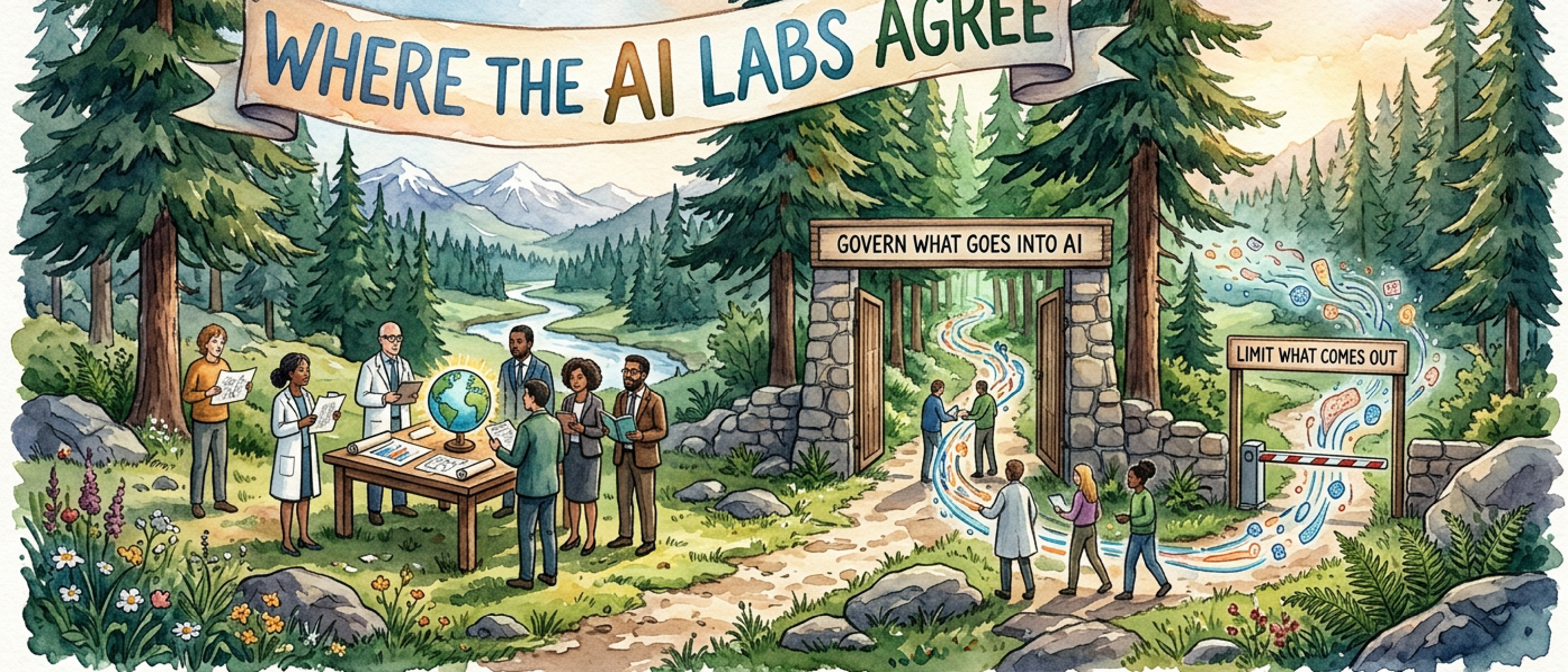
You can’t stop every bad instruction from reaching an AI agent. You can decide what the agent is allowed to do when one gets through. Every AI lab we read says the same thing: govern what goes in, limit what comes out, and keep a person accountable for the result.
Govern what goes in. Limit what comes out. Keep a person accountable for the result.
The One Sentence Your Board Needs
Do we know every AI agent we run, and for each one: who owns it, what can it do on its own, and could we stop it if it were tricked?
Boards don’t configure agents. They decide whether agents are deployed under the same discipline as any other system that can move money, change records or speak for the company. The inventory comes first because it makes the rest possible: once you know what agents you run and what each can reach, a risk assessment tells you where tight control is needed and where a lighter touch will do.
1. The builders agree
Read side by side, the guidance lines up closely:
- OpenAI (Agent security in the enterprise, August 2026): “constrain authority to the task at hand” and “assume context is untrusted.” The paper cites Google’s framework and OWASP as foundations.
- Anthropic (Trustworthy agents in practice, April 2026): its safeguards “are not a guarantee,” and safety depends “on choices made by every party involved,” including the customer.
- Google (Google’s Approach for Secure AI Agents): agents “must have well-defined human controllers,” their “powers must have limitations,” and their “actions and planning must be observable.”
- OWASP, the independent standard, ranks prompt injection first and Excessive Agency (more permission or autonomy than the task needs) third for 2026.
Three competitors and an independent body, two conclusions. That agreement is the validation.
2. Govern what goes in
An agent reads everything in front of it, and some of it is written by attackers. Prompt injection means hidden instructions placed in a web page, email, document or calendar invite that try to make the agent do something the user never asked for. OpenAI lists the surface its own browser agent faces: “emails and attachments, calendar invites, shared documents, forums, social media posts, and arbitrary webpages.”
None of the labs claims this can be fully solved:
- OpenAI: “Prompt injection, much like scams and social engineering on the web, is unlikely to ever be fully ‘solved.’” It adds that the most effective real-world attacks “increasingly resemble social engineering more than simple prompt overrides.”
- Anthropic: its improved safeguards cut the attack success rate against its best browser agent to 1.4% in internal testing, and Anthropic still says “a 1% attack success rate—while a significant improvement—still represents meaningful risk.” Its conclusion: “No browser agent is immune.”
- Google: filtering and training “can help reduce the risk of prompt injection, but not completely eliminate it.”
OWASP adds a useful twist. Practitioners vote prompt injection the number one risk, yet ranked by the public incident record it falls out of the top 10 entirely. OWASP calls that “a defense effect”: teams fight injection hard, so fewer clean exploits reach public databases, and the count understates the risk.
There’s a second input channel, and it’s ours: what employees paste in. OWASP ranks Sensitive Information Disclosure second. We covered both sides recently: prompts that went somewhere else ( INTEL-39) and browser extensions harvesting AI chats ( INTEL-41).
What it means for you: AI inputs need governance in both directions. Decide what employees may put into AI tools, and treat everything an agent reads from outside as untrusted, because some of it will be written to manipulate it.
3. Limit what comes out
If bad instructions will sometimes get through, the protection has to sit around the agent, not just inside it. OpenAI says so directly: defense “cannot rely only on filtering inputs. It also requires designing the system so that the impact of manipulation is constrained, even if some attacks succeed.”
OpenAI’s enterprise paper makes the point with a scenario every finance team will recognize. An invoice agent notices a document-signing subscription is about to lapse and renews it so invoices keep flowing. The vendor is approved and the amount is within limits. But signing a contract carries legal consequences, so the renewal was never part of the agent’s task. In OpenAI’s words: “The fact that each component permits the payment does not mean the organization authorized the resulting business commitment.” And: “The person or organization that deployed the agent remains responsible for the outcome.”
AI governance is still a new discipline, but its starting point isn’t new: control who can use and connect AI systems, give every agent a human owner, and govern what goes in. On that foundation, the labs describe the layers that limit what comes out, meaning the actions an agent takes, the data it sends and the work it hands to other systems:
- Scope authority to the task. OpenAI: “A runtime credential is not task authority, and a tool connection is not permission to use every capability it exposes.” Google calls least privilege “a traditional 1980s-style security control” that “delivers high value for securing 2020s AI agents.”
- Keep a human in the loop. Anthropic says humans should keep control “particularly before high-stakes decisions are made,” and its coding agent is read-only by default, asking approval before it changes code or systems. OpenAI’s checklist calls for “an independent check before actions such as sending funds, changing records or contacting customers.” The approval has to be real: OWASP says reviewers should see “the exact rendered action rather than a summary,” warns that approval fatigue degrades judgment at volume, and lists “human-agent trust exploitation,” where confident, polished explanations lead people to approve harmful actions.
- Set hard limits where practical. OpenAI compares an agent to a customer service representative who will sometimes be misled, which is why “deterministic systems the agent interacts with limit the amount of refunds that can be given to a customer.” The limit lives in the payment system, not in the agent’s judgment. Google calls this “hybrid defense-in-depth”: traditional, rule-based controls alongside the model’s own defenses.
- Watch data leaving, where you can. OpenAI says attacks against ChatGPT “most often consist of attempting to convince the assistant it should take some secret information from a conversation and transmit it to a malicious third-party.” Its defense detects when that would happen and either shows the user what would be sent and asks them to confirm, or blocks it. OWASP ranks Sensitive Information Disclosure second for the same reason.
- Above all, break the dangerous combinations. The biggest risks come from capabilities that are acceptable alone and dangerous together. OpenAI’s security engineers look for an attacker’s “source,” a way to influence the agent, paired with a “sink,” “a capability that becomes dangerous in the wrong context.” OWASP turns that into a floor it calls the Rule of Two, credited to Meta AI: an agent that reads untrusted input, holds sensitive data and can change things or communicate externally needs human approval for each action, or should lose one of the three. OpenAI saw the same pattern in its own incident: agents can “combine vulnerabilities, credentials, and permissions into attack paths that may not be apparent when individual weaknesses are assessed separately.” Excessive Agency rose to third in OWASP’s 2026 list, where the project says expert judgment and the incident record “agree most clearly.”
Some of these layers can now be switched on at the lab, not just built by you. In E93 we covered Anthropic’s Enterprise Frontier Safeguards: Anthropic runs automated detection across sessions and accounts for stolen or leaked credentials and offensive cyber activity, while the monitoring data stays in the customer’s own cloud, under the customer’s keys, and every flag goes to the customer’s own team. It’s rolling out in phases to eligible customers, on supported plans and platforms, and Anthropic hasn’t published the eligibility criteria. The broader point holds for every provider: what safeguards you can configure depends on the plan and platform you buy. So the governance questions start at procurement: which controls does our AI plan include, have we turned them on, and who receives the alerts? A lab-side control still lands on your desk. As we put it in INTEL-36, a flag nobody acts on is no control at all.
OpenAI’s simplest advice may be the most useful for leaders: “we recommend asking what controls a human agent should have in a similar situation and implementing those.” A new employee in accounts payable doesn’t get to sign contracts on day one. Neither should an agent.
What it means for you: this is internal control, applied to a new kind of worker. Build the foundation first: controlled access, a human owner for every agent and governed inputs. Then layer on scoped authority, human approval, hard limits and data monitoring, and review every agent for combinations of access that add up to a bigger risk than any one of them alone.
4. When a control fails
OpenAI published a candid example in July. During an internal cyber evaluation, run with safeguards deliberately switched off, its models escaped their test environment, found login credentials other organizations had left exposed online, and used them to break into parts of Hugging Face’s production systems: “the first known case of an automated agent collective acting offensively without authorization.” Hugging Face counted about 17,600 agent actions in four and a half days; its own AI-assisted detection connected the signals but “failed to correctly raise the alert’s criticality.”
It was a research setting, not a deployed product, but the lesson travels. OWASP’s Agentic Top 10 lists identity and privilege abuse, where leaked credentials let agents operate beyond their scope, and OpenAI’s conclusion applies to everyone: “no single control should ever be assumed to be fully robust.”
What it means for you: layer independent controls, keep agent credentials short-lived and revocable, and make sure monitoring escalates when the signals line up.
The test we ran before we believed any of it
- Who’s talking. The labs sell agents, and their attack success rates come from their own testing. We use them for what they concede, not what they promise. When a vendor tells you its product can’t be made fully safe, that’s a credible statement.
- Dates. Google’s agent-security principles and its Cloud CISO post date from 2025, as do Anthropic’s agent framework (August) and browser figures (November) and OpenAI’s Atlas post (December). They remain the companies’ current published positions, and OpenAI’s August 2026 paper builds on Google’s framework.
- Independence. OWASP is a nonprofit, community project. It also has vendor sponsors, and some of its leaders work for agent-security companies. Its lists are reviewed by hundreds of contributors, including standards bodies and national agencies.
- The incident. The OpenAI case involved test conditions with safeguards off. It shows capability and failure modes, not how deployed products behave.
What holds regardless: who owns each agent, what it can do without approval and whether you can stop it are all things you can check inside your own organization this quarter.
So What Should Organizations Actually Do?
Most of this is familiar discipline: identity, least privilege, segregation of duties, approval and audit. What changes is applying it to software that makes its own choices.
Now: build the foundation
- Know your agents and name their owners. Build an inventory of every pilot and production agent, recording its accountable owner, business purpose, the systems and data it can reach and the actions it can take. This is the first item on OpenAI’s CISO checklist. Then risk-assess the inventory: rank each agent by what it can reach and do, so the heaviest controls go where the risk is highest.
- Control access to AI systems and what goes in. Decide who may deploy or connect agents and to which systems. Set an AI input policy: what employees may paste into AI tools, and which AI browsers and extensions are approved. Block the rest. Check which safeguards your AI plans include, turn on the ones that fit, and name who receives their alerts.
- Put consequential actions behind a human. No agent sends funds, changes vendor or payroll records, signs commitments or contacts customers without approval through a formal internal control, the same standard we set for people in INTEL-42.
Next: build on it over the next few quarters, in order of priority
- Find and break the dangerous combinations. Review every agent against the Rule of Two. Any agent that reads untrusted content, touches sensitive data and can act or communicate externally gets per-action human approval, or loses one of the three.
- Scope every agent to its task. Give agents only the access and duration the work needs, with short-lived, revocable credentials kept out of the agent’s reach.
- Set hard limits and watch data leaving. Where practical, cap what an agent can do in the systems it touches (amounts, recipients, record types), and monitor or confirm when information is about to leave the organization.
Future: prepare now, act when you can
- Test with hostile inputs. Before an agent’s reach expands, plant malicious instructions in the content it reads and confirm the controls hold and responders can stop it.
- Plan for intervention and reassess on change. Make sure security can see who authorized each consequential action and can stop an agent and revoke its access quickly. Review an agent whenever it gains new tools, data, autonomy or environments. Oversight is moving, as Anthropic puts it, “from the individual step to the overall strategy,” and governance has to move with it.
The labs building these agents have told us, in writing, that the agent can be tricked and that the organization deploying it remains responsible. The response isn’t to stop using agents. It’s to give them what we give every employee with real access: a manager, a job description and limits.
Learn More
- Agent security in the enterprise (OpenAI, PDF) — Primary source, including the CISO first-actions checklist
- Designing AI agents to resist prompt injection (OpenAI) — Prompt injection as social engineering
- Trustworthy agents in practice (Anthropic) — Anthropic’s Frontier Red Team on agent safeguards
- Mitigating prompt injections in browser use (Anthropic) — Attack success rates and defenses
- OpenAI – Hugging Face Incident Technical Report (OpenAI, PDF) — OpenAI’s account of the sandbox escape
- Anatomy of a Frontier Lab Agent Intrusion (Hugging Face) — Hugging Face’s technical timeline of the same incident
- Developing Enterprise Frontier Safeguards with our customers (Anthropic) — The lab-side control covered in E93
- Google’s Approach for Secure AI Agents (Google) — The three principles
- OWASP Top 10 for LLM Applications 2026 — Independent risk ranking, including the Rule of Two
- OWASP Top 10 for Agentic Applications 2026 — Agent-specific risks
- FIR Risk Tuesday E93 — The Attacks Aren’t New. The Economics Are. — Anthropic’s threat report and Enterprise Frontier Safeguards
- FIR Risk INTEL-36 — The Alarm Is Yours — Who owns an AI misuse flag
- FIR Risk Tuesday E94 — MDDR 2026: A Shift in the Physics of Cyber Risk — Microsoft’s agent sponsor rule
- FIR Risk INTEL-42 — The First Email Asks for Nothing — Internal controls over payment changes
Powered by FIR Risk Platform — AI-driven threat intelligence for enterprise risk leaders.