Why a risk advisory is reading 10-Qs
As a risk advisory focused on technology, I built the FIR Risk Platform to ingest SEC filings. They are one of the most useful public sources of risk intelligence available: they gather the risk factors companies disclose, and show how those companies view their own risks in their own words.
The big tech trend is an important signal to watch for the future economy. Assessing big tech’s disclosures also gives us a look at how the companies closest to the rapid pace of technology and innovation see their risks, so other companies can learn from those assessments and use what is useful.
Risk is there to be managed. We work to understand it so organizations can adopt new technology and innovation to stay competitive, become more efficient, and lean into innovation.
— Bruce, FIR Risk Advisory
Bottom Line
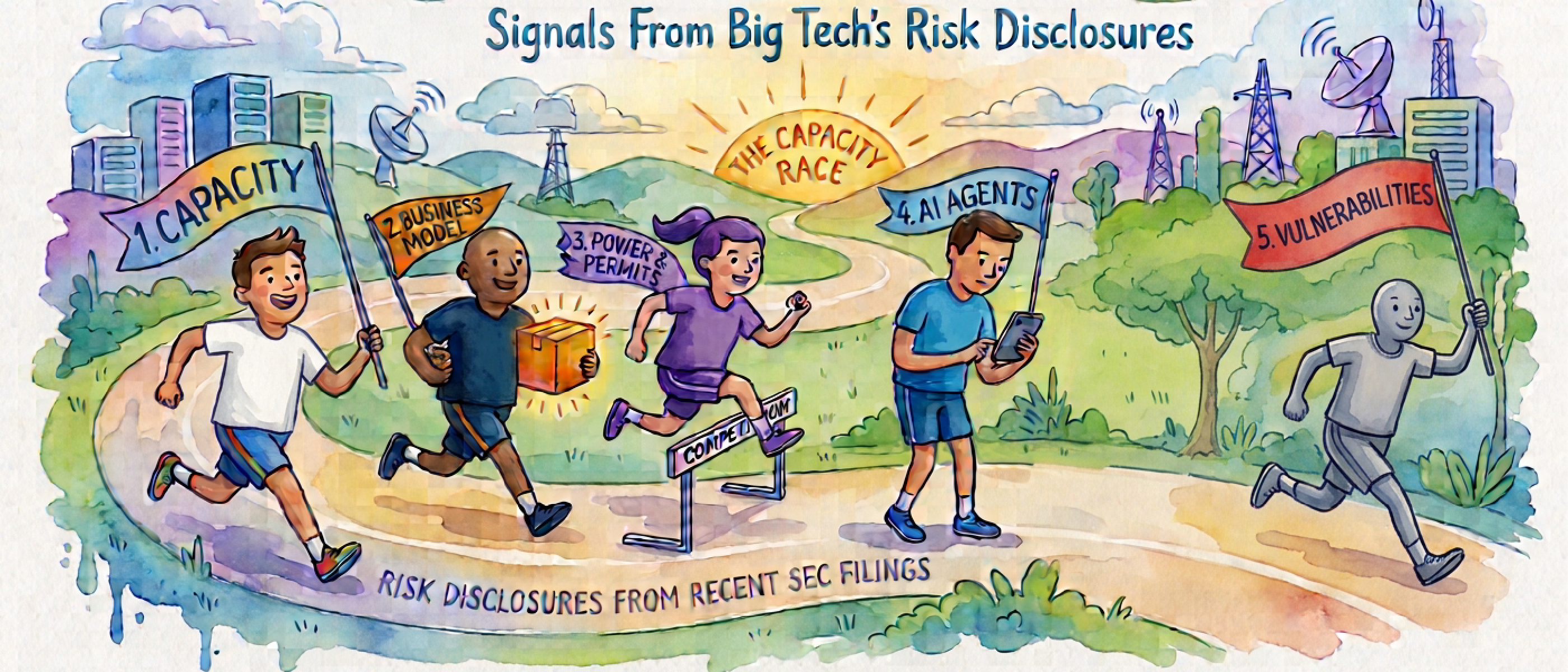
Big tech is racing to lock up computing capacity, power and chips years in advance, on the bet that AI adoption is arriving fast and that capacity will be scarcer and costlier later than it is today. The filings show this is a shared strategy, not one company’s gamble, and that it is now funded with debt and new shares. How much risk each company carries depends on its business model. For everyone else, these companies are critical suppliers, and their filings now describe AI agents as insiders and AI as accelerating the discovery of software flaws. Their risks are now part of yours.
Treat your AI and cloud providers as concentrated suppliers in a race, and plan for what the race costs you.
The One Sentence Your Board Needs
Which AI and cloud providers do our critical operations depend on, and would our plans hold if one of them changed its prices, capacity or terms?
Boards don’t need to follow capital markets. They can ask whether the company knows which providers it can’t operate without, and whether it has a plan if one of them changes. The filings show those providers have taken on far more long-term commitments, and more debt, than they had a year ago.
1. Read it as disclosure, not prediction
How we read these filings, and what they can and can’t tell you:
- We compared like with like. Each company’s most recent risk factors against the same filing a year earlier: the third-quarter 10-Q for Amazon, Meta and Microsoft (Microsoft’s fiscal first quarter); the annual 10-K for Apple and Oracle; and for Alphabet, the 10-K plus the “material changes” its third-quarter 10-Q added this year, where the same quarter last year added none. Microsoft, Oracle and Apple have fiscal years that don’t match the calendar, so each is compared with its own prior year, not with each other.
- What changed matters more than what’s listed. Risk factors are written by lawyers to protect the company, so no single sentence is news. A company listing a risk is not predicting it. When a company adds a new risk factor, rewrites an old one, or starts naming a figure, it is telling investors something has moved.
- We looked for patterns, not headlines. A risk that several companies add at the same time is a signal. One company’s wording is not.
- This is not investment analysis. We are not commenting on valuations or stock prices. We are reading these companies as suppliers to everyone else.
By our count, the risk-factor sections grew by about 16% at Microsoft, 26% at Apple and 30% at Oracle compared with a year earlier. Amazon’s barely changed; more on that in signal two.
2. Signal one: a race to lock up capacity
The most striking pattern is how much these companies have committed to pay for, years ahead, whether or not the demand arrives. Each reports it differently, so the figures are not comparable or additive, but the scale is consistent:
- Alphabet: $924.4 billion of purchase commitments, $802.1 billion of them multi-year commitments for technical infrastructure, energy take-or-pay contracts and content, plus $130.5 billion for leases not yet started, mostly data centers and energy infrastructure. It also added that it has given “backstops and financial guarantees to support the build-out of third-party data centers and power infrastructure.”
- Amazon: $883.6 billion of total commitments including its debt, of which $164.9 billion is for leases not yet started.
- Microsoft: $743.8 billion of contractual obligations at the end of June, including its debt, $443.5 billion of leases and $194.1 billion of purchase commitments, which it says relate primarily to data centers.
- Oracle: its customer cloud contracts generally run one to five years and renew at the customer’s option, while its new risk factors say its data-center leases “do not align with the duration and pricing of customer contracts.”
Why would they do this? The filings answer it themselves. Capacity bought later, or bought short-term, costs more:
- Anthropic says the short-term compute it buys when demand spikes “currently costs significantly more than comparable compute procured under our multi-year commitments.”
- Microsoft says it may be able to get scarce components “only by entering into long-term purchase commitments, price commitments, paying prices above prevailing market rates.”
- Anthropic says “access to sufficient compute on economical terms could become the primary constraint” on its business, and that competitors who secure it “may be better positioned to remain at the frontier of AI.”
Our read: when every major builder signs the same kind of long, non-cancelable commitments at the same time, it is not one company being reckless. It is a shared bet: that AI adoption is arriving fast over the next decade, that capacity, power and chips will be scarcer later, and that capacity secured at today’s prices beats waiting for technology to bring costs down. A company that won’t commit risks being left out of the race.
The race is now funded with borrowed money and new shares. Capital spending roughly doubled: Alphabet $132.0 billion in the first nine months of 2026, up from $63.6 billion; Amazon $77.3 billion in the third quarter alone, up from $35.1 billion; Microsoft $39.4 billion in its September quarter, up from $19.4 billion before finance leases; Oracle $28.5 billion in its August quarter, up from $8.5 billion. Between October 29 and November 5, the companies raised more than $72 billion, plus €6 billion, in bonds, shares and preferred stock, according to their 8-K filings. Microsoft sold $25 billion of bonds with maturities out to 2066. Oracle sold $10 billion of new shares and $10 billion of bonds, on top of $129.5 billion of debt at the end of May. Over the last twelve months, Amazon’s free cash flow was negative $42.4 billion, and it brought in $124.1 billion from financing, including a $17.5 billion term loan.
Some of the money moves in circles. The builders are also financing the companies that buy their capacity. Amazon invested $50.0 billion in OpenAI’s preferred stock and $10.0 billion in Anthropic’s in the first nine months of 2026. Microsoft calls itself “a major investor in OpenAI,” and its quarterly results now swing with that stake: $4.1 billion of net losses a year ago and $272 million of gains this quarter, which it excludes from its adjusted results. Alphabet now discloses $75.7 billion of backstops for data centers, including $10.0 billion with Crux AI, which it identifies as a related party, plus $22.8 billion of guarantees so its counterparties can order power equipment. And Anthropic, which has committed about $895 billion to compute, earns 44% of its revenue through the builders’ own cloud marketplaces.
Our read: in a race, financing your own demand is rational, but it links the risks. A setback at a major model maker, or at a partner a builder has guaranteed, would travel through investors, suppliers and customers at the same time.
The other side of the bet is in the filings too. Microsoft added that overestimating demand “may lead to impairment of assets on our balance sheet.” Oracle says that if customers don’t renew, it could be “locked into multi-year commitments for excess data center space… without receiving corresponding revenue.”
What it means for you: the cost of the race is recovered from customers. Expect your providers to push for longer terms, minimum spend and committed-use contracts, and decide how much lock-in you are willing to accept before you sign.
3. Signal two: who carries the risk depends on the business model
The same race carries very different risk depending on how each company makes its money:
- Builders that also sell the capacity: Microsoft, Amazon and Alphabet. They build data centers for their own products and rent the capacity to everyone else, so cloud customers help pay for the bet. Cloud revenue is growing fast: Microsoft’s Azure revenue was $33.2 billion in its September quarter, up from $22.4 billion; Amazon’s AWS sales grew 39% in the third quarter; Google Cloud revenue rose $15.6 billion over the same quarter a year earlier.
- A seller that leases what it sells: Oracle. It rents much of its data-center capacity on long leases to serve cloud contracts that customers can choose not to renew, and it now warns about that mismatch and about customers’ ability to pay. Its contracted backlog is $664 billion, up from $455 billion a year earlier.
- A builder for its own use: Meta. It says it generates “substantially all” of its revenue from advertising, and it has no cloud business to resell capacity. It reports $454.52 billion of non-cancelable commitments, most of them for third-party cloud capacity and technical infrastructure, It has turned to preferred stock and bonds, and plans a new class of non-voting shares for future equity offerings. Its returns depend on AI improving advertising and products, not on renting capacity to others.
- A renter: Apple. Its capital spending fell, to $9.0 billion in fiscal 2026 from $12.7 billion. It relies on third-party cloud providers for AI computing, and now says there are “limited third-party providers that can reliably meet such demand.”
- A model maker: Anthropic. It buys capacity from the builders and sells AI to businesses, 44% of it through the builders’ own cloud marketplaces. More in the special section below.
Our read: the risk of the race is not spread evenly. Companies that can resell capacity can pass part of the cost to customers. Companies building for their own use carry it themselves, and companies that rent depend on the builders’ prices and priorities.
Amazon is the exception that proves the method. Its capital spending more than doubled while its risk factors barely changed. It already warned a year ago that misjudging demand can mean “excess or insufficient fulfillment or data center capacity… and impairment charges,” and its $883.6 billion of commitments are disclosed in full in its notes. Amazon writes broad, stable risk factors and puts the numbers in its financial statements.
What it means for you: most organizations are in the renter’s position. Know which model each of your critical providers runs, because it shapes how they will price, what they will prioritize when capacity is short, and how exposed they are if demand disappoints.
4. Signal three: power, permits, people and parts
The builders now describe physical limits on how fast anyone can grow:
- Power. Microsoft added new language on electricity: grid constraints, delays in getting connected, and the cost of power. Alphabet says its growth is “increasingly constrained by the availability of power, water, and land.” Oracle added that rising energy costs “can adversely affect our margins, particularly where customer pricing is fixed or committed,” and that its long-term power contracts “may extend beyond customer contract terms.”
- Permits and local opposition. Microsoft now cites “community opposition, state and local moratoriums, and hyper-local dissent.” Oracle cites government “limits or moratoria on data center construction.”
- People. Microsoft added shortages of skilled construction and operations workers.
- Partners’ financing. Oracle added that it depends on third parties to build some of its data-center capacity, and “their inability to obtain financing, complete construction on schedule or manage construction cost overruns could delay the availability of data center space or increase our costs.” Anthropic says the same about its compute suppliers (see the special section below).
- Parts. Apple says supply constraints and rising costs for memory and storage are expected “to intensify.” Microsoft lists shortages of chips, networking, power systems and cooling equipment.
These limits are part of why the race exists: if capacity can’t be built fast enough later, securing it now looks safer.
What it means for you: AI capacity is not unlimited, and its cost is tied to energy and hardware markets. If a critical process depends on an AI service, plan for slower availability or higher prices at some point, not just for an outage. Expect energy-cost pass-through or price-indexing clauses at renewal, and ask whether your provider’s capacity depends on someone else’s financing.
5. Signal four: your infrastructure suppliers describe AI agents as insiders
These companies supply the cloud, software and AI that most organizations run on, so how they describe AI agents, software that can take actions on its own, matters to their customers:
- Microsoft: AI models and agents with access to internal systems “may present risks similar to those associated with highly privileged users or threat actors,” and “the risks associated with AI and cybersecurity increasingly overlap and amplify one another.”
- Apple: agents may behave in unexpected ways, “including by taking actions that were not directed, instructed or authorized, exceeding permissions, defying directions or resisting instructions.”
- Alphabet: “During model testing, we have sometimes observed unexpected behavior, including autonomous agents taking actions outside of their intended scope.”
Two new lines go to the heart of how agents should be controlled:
- Apple: “Some consequences, such as deleting data or completing transactions, may be difficult or impossible to reverse,” and its “ability to oversee and control third-party artificial intelligence agents and other technologies may be limited.”
- Alphabet: agents may “execute multi-step actions without adequate human review.”
Our read: the builders are naming the exact failure that human approval is meant to catch.
Microsoft also adds a related risk: errors and vulnerabilities in code written by AI. This builds on what the AI labs told us in E95: govern what goes into an agent and limit what it can do.
What it means for you: if the companies building agents treat them as privileged insiders, so should you. Give every AI agent its own identity, with the least access it needs, and require a person to approve anything that moves money, changes production systems or deletes data.
6. Signal five: a race to find flaws first
The builders now say AI is speeding up the discovery of software flaws, for attackers and defenders alike:
- Microsoft: “The continual advancement and diffusion of AI models is accelerating vulnerability discovery,” and it is responding “through the deployment of AI-based and automated defenses.”
- Alphabet: “The use of AI to find and exploit vulnerabilities is accelerating timelines on which such vulnerabilities may be discovered and exploited by threat actors.”
- Apple: AI is “generating deepfake content designed to bypass authentication protocols” and “identifying and exploiting vulnerabilities at a greater scale and at a highly accelerated pace.”
- Anthropic says it held back its frontier model, Mythos, in April 2026, releasing it first only “to select organizations for cybersecurity applications” because of its “advanced capabilities in cyber vulnerability discovery.”
Our read: this is a second race. The same AI that helps attackers find flaws helps software makers find and fix them first, in their own products and in the open-source code everyone relies on. Companies that use AI to secure the code they ship, and the code their customers depend on, will have an advantage over those that can’t or don’t. It matches what we found across our whole library for FIR SIGNALS 2026: the window between a flaw becoming known and being exploited keeps shrinking.
What it means for you: assume less time to patch internet-facing systems and resource automated patching. Ask your critical software vendors how they are using AI to find and fix flaws in their own products before attackers do.
7. Special section: Anthropic’s IPO filing
Anthropic is not yet public. It filed for an initial public offering on October 26 (proposed Nasdaq symbol “ANT”) and amended the filing on November 2. A first-time filer has no prior year to compare against, so we compared the amendment with the original filing a week earlier.
Disclosure: FIR Risk uses AI models from several providers, including Anthropic.
A different business model. Anthropic sells AI to businesses and developers rather than running a cloud or an advertising business, and 44% of its revenue in the first nine months of 2026 came through the cloud marketplaces of the big providers. That puts it on both sides of the capacity race: a large buyer of computing power, and a seller whose growth depends on enterprise adoption.
The numbers, as of September 30, 2026:
- Revenue of $33.2 billion for the first nine months of 2026, up from $2.5 billion in the same period of 2025.
- Compute and infrastructure costs of $18.8 billion over the same nine months, and an operating loss of $1.3 billion. The reported net loss of $104.0 billion is mostly a $94.3 billion non-cash charge from revaluing convertible notes as the company’s valuation rose.
What the amendment added:
- The size of its commitments. The original filing left the figure blank. The amendment puts Anthropic’s committed spending on compute and infrastructure at about $895.4 billion, including $447.5 billion before the end of 2030 and $69.8 billion due within twelve months. Many of these contracts are “take-or-pay”: Anthropic pays whether or not it uses the capacity. It is the same race, from the buyer’s side.
- Its suppliers’ financing. Some of its compute providers “depend on third-party financing or credit support to acquire chips,” so contracted capacity “may be delayed, repriced, reduced, or not delivered” if that financing dries up.
- Its own safety threshold. Anthropic says its internal estimates for future models indicate it “may imminently meet” the point in its Responsible Scaling Policy that marks “dramatically accelerated progress attributable to AI.” It has not designated any current model as crossing that line, and says it is considering policy updates “to keep humans in control of frontier model development.”
- Checking AI with AI. “Models, including our own, that are used to assess the behavior of other models have engaged, and may in the future engage, in misaligned behavior.”
What stayed the same, and matters most to buyers: Amazon, Google and Microsoft are Anthropic’s investors, customers, distribution partners and competitors at the same time, a relationship the filing says creates “potential conflicts of interest that are difficult to fully anticipate or mitigate.” The same few companies sit on every side of the AI supply chain. If your business depends on one AI model, that circularity is part of your concentration risk.
What it means for you: read Anthropic’s filing as a view from the other side of the market. Big tech warns about depending on outside model makers. The model maker warns about depending on big tech for computing power. Your organization likely depends on both.
So What Should Organizations Actually Do?
None of this calls for pulling back from AI or cloud. The companies building it are leaning in, and so should yours, with these risks managed rather than ignored. That starts with treating these providers as the concentrated suppliers they have become. Six lines worth adding to your risk register:
Now: know your dependencies
- AI and cloud provider concentration. List the AI models and cloud platforms your critical processes depend on, note which business model each provider runs, and where one provider supplies more than one layer.
- AI agent access. Give every agent its own identity and the least access it needs, and require human approval before agents complete transactions or change production systems.
- Shrinking patch window. Confirm internet-facing systems are patched automatically, and ask critical software vendors how they use AI to find and fix flaws in their own products.
Next: build it into contracts and planning over the next few quarters
- Vendor financial health. Add credit ratings, debt levels and capacity commitments of critical technology providers to your third-party reviews, and the AI partners they have invested in or guaranteed.
- Price and lock-in. Before signing multi-year AI or cloud commitments, model the cost if prices rise or usage falls, keep an exit path for critical workloads, and decide whether locking in capacity now is worth it for your own business.
Future: watch the physical limits
- Capacity and power. Ask critical providers where your workloads run and how they plan for power or capacity constraints, and plan for slower availability or higher prices, not just an outage.
The companies building AI have told regulators, in writing, that they are racing to secure the capacity the next decade will need. The best use of that disclosure is to decide where your organization stands in that race, and to make sure your own plans account for what it costs.
Not yet covered: Nvidia reports later in November, SpaceX and Tesla get their own edition, and OpenAI is private and files nothing.
Coming next: FIR SIGNALS 2026, our annual report on the risk signals that held up across a full year of evidence. Two of them, the shrinking window to patch and the risk inside your own AI, show up again in these filings.
Learn More
- Alphabet Form 10-Q, quarter ended September 30, 2026
- Amazon Form 10-Q, quarter ended September 30, 2026
- Apple Form 10-K, fiscal year ended September 26, 2026
- Meta Form 10-Q, quarter ended September 30, 2026
- Microsoft Form 10-Q, quarter ended September 30, 2026 and Form 10-K, fiscal year ended June 30, 2026
- Oracle Form 10-K, fiscal year ended May 31, 2026 and Form 10-Q, quarter ended August 31, 2026
- Anthropic, PBC Form S-1/A, November 2, 2026
- FIR Risk Tuesday E95 — The Labs Agree — what the AI labs say about governing agents
Powered by FIR Risk Platform — AI-driven threat intelligence for enterprise risk leaders.